

For roughly 36 lakh EPS-95 pensioners, the “minimum pension” still means just ₹1,000 a month. That’s less than the price of a basic monthly medicine bill in many Indian households, which is exactly why the EPFO minimum pension hike keeps coming back into the headlines.
The short version: there has been no final government notification raising the EPFO minimum pension yet. Pensioners’ groups are demanding a hike to ₹7,500 per month plus dearness allowance, but as of the latest public updates from the Labour Ministry and EPFO, the official minimum under the Employees’ Pension Scheme, 1995 remains ₹1,000.
What is the latest update on the EPFO minimum pension hike?
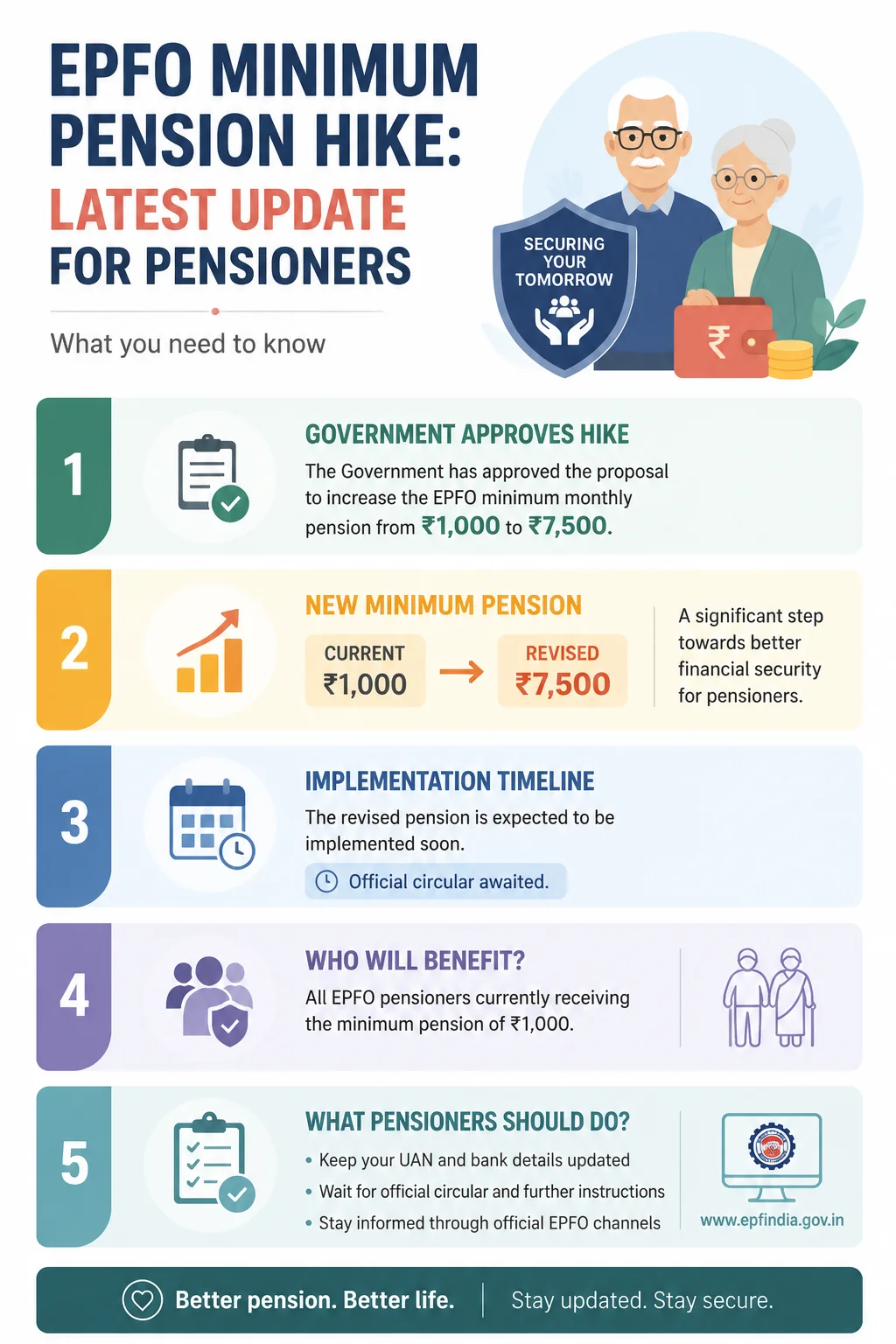
The current minimum pension under the Employees’ Pension Scheme, 1995, better known as EPS-95, is ₹1,000 per month. This floor was introduced by the central government in September 2014. Before that, many retired private-sector workers were receiving shockingly low pensions, sometimes a few hundred rupees.
Since then, pensioners’ associations have repeatedly asked the government to raise the minimum pension. The most common demand is ₹7,500 per month with DA, along with medical benefits for elderly pensioners and their spouses.
But here’s the thing. A demand, even a loud and fair-sounding one, isn’t the same as an approved hike. For the pension amount to change, the government has to approve it and issue a formal notification. EPFO then implements it through its field offices and pension disbursing banks. That hasn’t happened yet.
Why pensioners are pushing so hard
Anyone who has sat with an elderly pensioner at a bank branch knows the mood around this issue. It’s not theoretical. It’s deeply personal. I’ve seen retired factory workers compare their pension slips with their medicine bills, and the numbers look absurd side by side.
EPS-95 covers employees from organised-sector establishments under EPFO. These are people who worked in factories, private companies, schools, cooperatives, hotels, transport firms and small industrial units. Many retired after decades of service, only to find that their monthly pension barely covers groceries.
Inflation has done the real damage. A ₹1,000 pension in 2014 was already modest. In 2026 terms, it feels almost symbolic. The Reserve Bank of India’s consumer inflation data over the past decade shows steady pressure on food, fuel, healthcare and rent. Pensioners feel that pain first.
What pensioners’ groups are demanding
The National Agitation Committee of EPS-95 Pensioners has been one of the most visible groups pressing for a higher pension. Its demand has usually included three key points:
- Minimum pension of ₹7,500 per month
- Dearness allowance linked to inflation
- Free or better medical facilities for pensioners and spouses
The argument is simple: if government employees receive pension protection and inflation-linked benefits, why should long-serving private-sector retirees be left with ₹1,000? It’s a politically powerful question. And honestly, it’s hard to dismiss when you meet the people affected.
Why hasn’t the hike been approved yet?
This is where the business side kicks in. EPS-95 is not a simple welfare handout. It’s a pension fund with contributions, actuarial calculations and long-term liabilities. Translation: someone has to pay for every rupee promised.
Under EPS, an employer contributes 8.33% of the employee’s pensionable salary to the pension fund, subject to the statutory wage ceiling. The central government also contributes 1.16% of wages, again within the ceiling. The pensionable salary ceiling has been ₹15,000 per month since 2014.
If the minimum pension jumps from ₹1,000 to ₹7,500, the extra cost won’t be small. The Labour Ministry has told Parliament in past replies that any increase must consider the scheme’s financial sustainability and actuarial valuation. Dry phrase. Big meaning.
An actuarial valuation is basically a stress test of the pension fund. It estimates how much money the scheme has, how many pensioners it must pay, how long people are expected to live, and what future liabilities look like. If the math doesn’t work, the government either has to increase contributions, provide budget support, or change scheme rules.
What Parliament and committees have said
The issue has been raised several times in Parliament. Members across parties have asked why EPS-95 pensioners are still stuck at ₹1,000. The Parliamentary Standing Committee on Labour, Textiles and Skill Development has also flagged the inadequacy of the current pension in its reports.
In earlier committee discussions, the ₹1,000 minimum pension was described as insufficient, especially given the age and medical needs of pensioners. That matters because parliamentary committees don’t issue policy directly, but they do put pressure on ministries. Sometimes that pressure works. Sometimes it gathers dust. Welcome to policy-making.
The Ministry of Labour and Employment has generally responded by saying that the pension fund’s position, government contribution and long-term commitments must be assessed before any hike is approved.
Is the higher pension option the same as the minimum pension hike?
No. And this is where many pensioners get confused.
The higher pension option came into focus after the Supreme Court judgment dated November 4, 2022, which allowed eligible EPFO members to apply for pension on higher wages, subject to conditions. That case dealt with employees who had contributed or wanted to contribute on wages above the pensionable salary ceiling.
The minimum pension hike is a separate issue. It affects pensioners who receive low EPS pensions and want the base pension raised from ₹1,000. So if someone tells you, “EPFO higher pension means everyone will now get ₹7,500,” don’t buy it. Wrong file. Different fight.
What could happen next?
There are a few realistic possibilities. None are guaranteed, but they’re worth watching.
- A modest hike: The government may raise the minimum pension, but not to ₹7,500. A smaller increase would be easier to fund.
- Budget-backed support: The Centre could provide extra budgetary assistance to keep EPS financially stable.
- DA-linked pension: Pensioners want inflation protection, though this would create a recurring cost every year.
- No immediate change: The government may continue studying the proposal without announcing a hike. Frustrating, but possible.
The most useful signal will be a formal announcement from the Ministry of Labour and Employment, the Union Budget, or an EPFO circular. Social media posts, WhatsApp forwards and YouTube thumbnails shouting “₹7,500 approved” don’t count. Sorry, uncle.
How pensioners can check genuine updates
Pensioners should keep an eye on official sources, not rumor mills. The most reliable places are:
- EPFO website: epfindia.gov.in
- Ministry of Labour and Employment releases
- Lok Sabha and Rajya Sabha question answers
- EPFO circulars sent to regional offices
- Pension payment orders and bank credits
If a hike is approved, pensioners won’t need to guess. It will show up through a government notification, EPFO implementation instructions and eventually in the monthly pension credit. Paper trail first. Money later.
What pensioners should do now
First, make sure basic EPFO records are clean. Name, date of birth, Aadhaar, bank account, PPO number and life certificate details should match. A pension hike, whenever it comes, is no help if the payment gets stuck because of a spelling mismatch from 1998.
Second, submit the Jeevan Pramaan life certificate on time. Most pensioners can do this digitally through Aadhaar-based biometric authentication, or at bank branches, post offices and common service centres. Miss it, and the pension may stop until records are updated.
Third, don’t pay agents who claim they can “process” a minimum pension hike. There’s no private shortcut for a government-approved increase. If the minimum is raised, eligible pensioners should receive the revised amount through the system.
The bottom line for EPS-95 pensioners
The demand for an EPFO minimum pension hike is real, loud and politically difficult to ignore. The current ₹1,000 floor looks painfully outdated, especially for retirees dealing with rent, food inflation and healthcare costs.
Still, the latest position is straightforward: the ₹7,500 minimum pension has not been officially approved. Until the government issues a notification, EPS-95 pensioners should treat every “hike confirmed” message with caution.
Will the pension rise eventually? It may. The pressure is building, and the case for a better minimum pension is strong. But pension policy moves slowly in India. Sometimes painfully slowly. For now, pensioners should watch the official channels, keep their records updated, and keep receipts of everything. Because when the file finally moves, you don’t want paperwork to be the thing standing between you and a higher pension.